Noah cups coffees and works on his Coffee Value Assessment skills
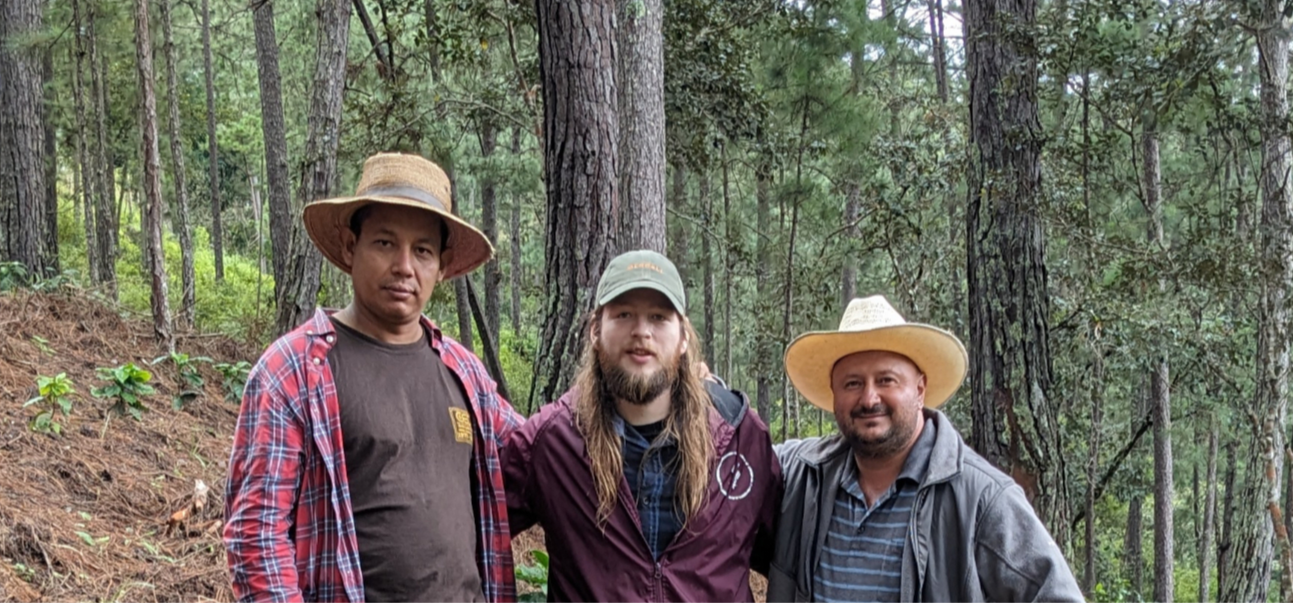
Hi everyone, Noah here! I am the production manager in the roastery, a barista, “bakery errand boy”, etc. I’ve worked here at Tug Hill for over 2 and a half years now. In that time I have had many opportunities to learn and grow as a person. Some of these opportunities include sourcing trips to Honduras and Guatemala, competing in a barista competition in Montreal, and taking a local leadership class run by Naturally Lewis. Today I want to tell you about my most recent opportunity, a trip to Montreal to take a three day coffee sensory class.
I am a person who is more comfortable hiking in the woods by myself or engaging with a customer while making them a pour over than being in a big city like Montreal. So jumping in my car Sunday afternoon I was nervous for the trip but also excited to learn. Halfway through my drive I stopped for a walk to calm my nerves and had the cool experience of hand feeding a couple of chickadees on the trail.
For some background on why I took this class. Education is vital to the entire coffee process. Producers (like Armando) take agronomy classes, roasters take roasting classes, and I took this sensory class. The Specialty Coffee Association is a leader in all types and levels of coffee education. This specific class was for Intermediate sensory skills.
Monday morning I arrived at the warehouse and met my instructor Andrea Oneli and my five classmates. Andrea is an authorized Specialty Coffee Association trainer and profession in sensory and roasting. He has a coffee education school in Bogota, Colombia. Over the course of three days we dived into the theory of sensory skills. Learning about how our senses of taste and smell work together when we consume coffee. Many practical exercises to test and develop our senses, and lots of coffee cupping. One specific exercise that we did twice is called triangulation. This is a coffee sensory evaluation that is used not to test the coffee but to test the coffee taster. In fact it is used as the format for World Cup Tasters championships. For triangulation you set up groups of three cups, two cups have the same coffee and one cup has a different one. The challenge is to correctly identify the cup containing the different coffee. On Monday we did 4 of these groups and I only got 2 correct. When we did it again on Wednesday I was able to get all 6 of the groups correct!
A big part of coffee sensory skills is learning about the coffee value assessment (CVA) , a cupping form and grading system used worldwide in the specialty coffee world. The CVA replaced the old cupping form officially just last year. Learning from and practicing cupping with a professional like Andrea was an incredible experience. I feel more confident in my own skills which I am excited to continue to hone. Time to practice cupping has been limited in the past working for a busy small business, but now I am setting up different cupping exercises for Scott, Aiden and myself every Monday. In the future I am hopeful that I will be able to take more classes. For now I am safely back from Montreal with a SCA certificate in intermediate sensory skills


A conversation about understanding media messages more carefully seems most useful to me when it leaves space for uncertainty and further questions. Separating a claim from the evidence offered for it makes a message easier to examine. I would use that point as a starting question when considering media literacy skills. I do not have a settled view yet, but this seems like a good place to slow down and look more closely. What questions should readers ask before sharing a striking headline?
There is something approachable about discussing making online tutoring sessions effective through situations people can actually picture. A clear question before a session can help the learner use the available time well. It makes me curious about the practical side of online tutoring support. I would be interested in a simple example, because it is often the ordinary details that make an idea memorable. How would you check that a tutoring explanation has actually become understandable?
What interests me about choosing a college learning environment is how a broad idea becomes part of an ordinary day. The way a course is taught can affect whether a student feels comfortable asking for help. I would keep that thought nearby when looking for ideas about college study choices. I do not have a settled view yet, but this seems like a good place to slow down and look more closely. What would you ask about teaching and support before choosing a college?
Considering sharing the everyday questions of parenthood, I keep coming back to the difference between knowing about an idea and putting it into practice. Small concerns can be easier to discuss when parents hear that others have similar questions. For me, that is a useful way into the broader subject of parenting support discussions. I am more curious about the process than a polished result, because the steps in between are usually where questions appear. What makes a parenting discussion feel helpful rather than competitive?
The subject of connecting historical names with local education feels more interesting when there is room for a reader to stop and ask their own questions. A school's name can provide a route into discussing a wider historical period. Seen this way, Jagiellonian history education becomes a topic to explore rather than something to sum up too quickly. I am still thinking through the details, and a small example would help me picture how this works in practice. How can students explore a historical figure without reducing the lesson to a list of dates?